
Rear-End Accident Lawyer in Queens, NY
Were You Injured in a Rear-End Crash in Queens?
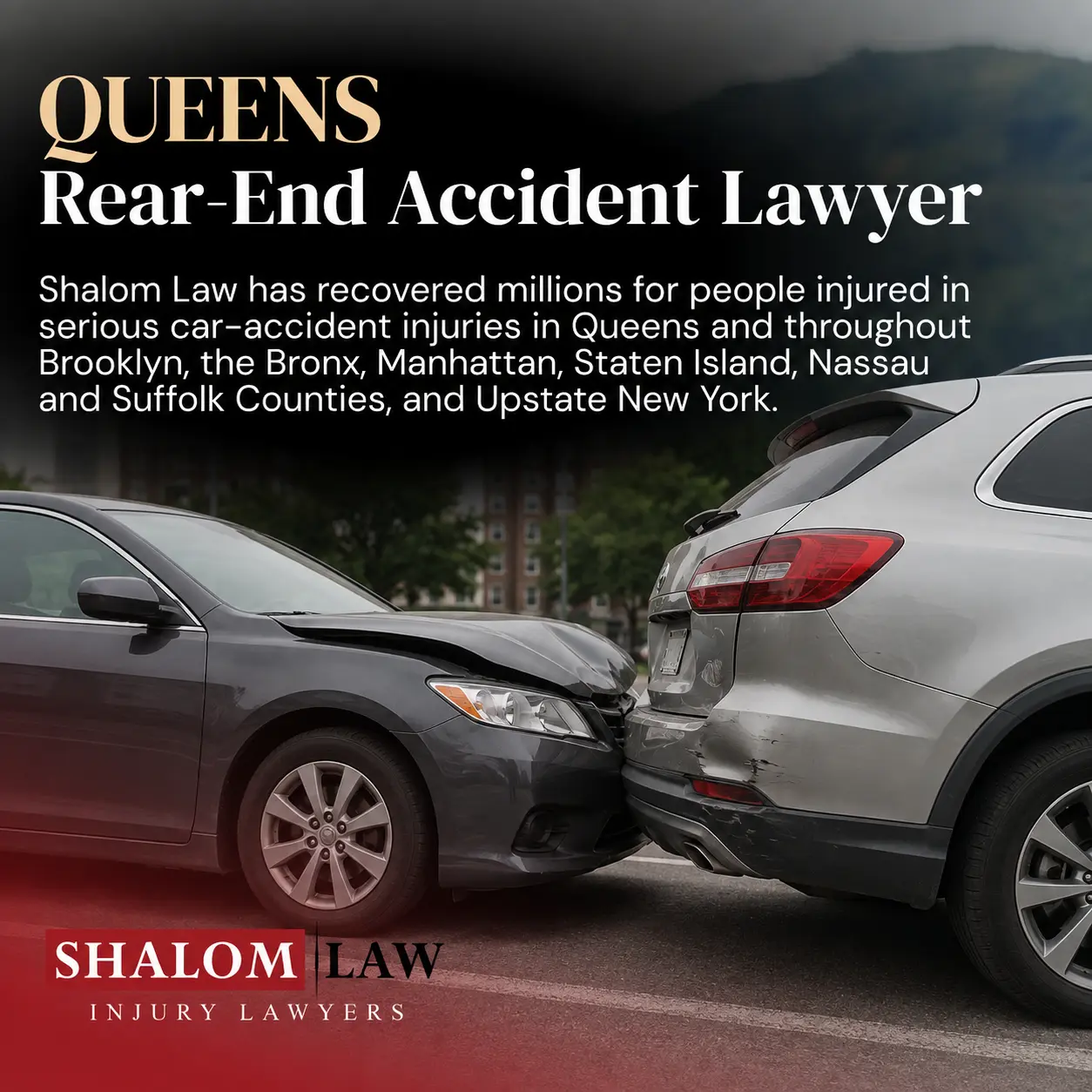
Shalom Law has recovered millions for people injured in rear-end crashes throughout Queens, including Forest Hills, Jamaica, Flushing, Astoria, Long Island City, Jackson Heights, Elmhurst, Rego Park, Bayside, Ozone Park, and the Rockaways.

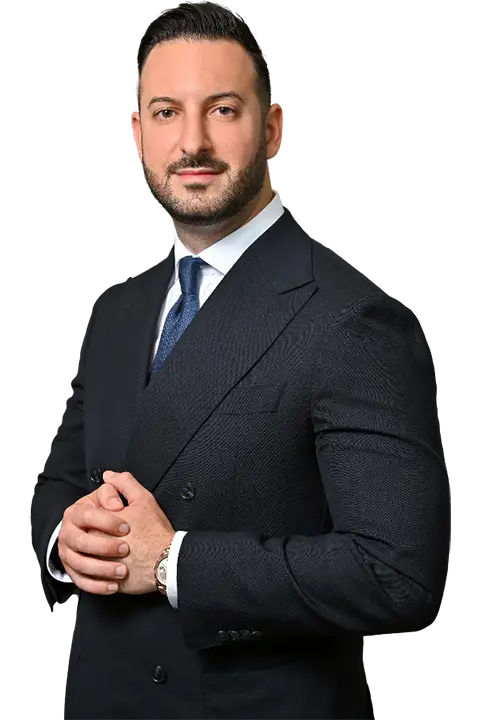
Jonathan Shalom
Founder

$1,800,000
Tractor Trailer Accident

$900,000
Rear-end Collision
$1,000,000
Truck Accident
$340,000
Truck Accident

$295,000
Construction Accident

$140,000
Motorcycle Accident

$125,000
Slip and Fall Accident

$130,000
Hit and Run Injury
$225,000
Scaffolding Accident
$170,000
Semi-Truck Accident
$500,000
Construction Accident

$245,000
Bus Accident

$150,000
Uber Accident
$200,000
Tractor Trailer Accident
$350,000
Construction Site Accident
$210,000
18-Wheeler Accident

$450,000
Pedestrian Accident
$325,000
Construction Accident
$200,000
Truck Accident
$583,000
Commercial Truck Accident
Shalom Law
Over $50 Million Dollars Recovered for Our Clients!
A rear-end collision can happen in seconds, but the resulting pain, medical bills, lost income, and insurance problems may continue for months or years. Congested Queens corridors such as Queens Boulevard, Northern Boulevard, Woodhaven Boulevard, Jamaica Avenue, Hillside Avenue, and Main Street create frequent stop-and-go conditions. Expressways and parkways—including the Van Wyck Expressway, Long Island Expressway, Grand Central Parkway, Belt Parkway, and Cross Island Parkway—also require drivers to react quickly to changing traffic.
Shalom Law represents people injured when another driver follows too closely, looks at a phone, speeds, drives while impaired, or fails to brake in time. Our team investigates how the impact occurred, preserves evidence, identifies every available insurance policy, and pursues the compensation allowed by New York law.
Even a collision that appears “minor” can produce whiplash, disc injuries, concussions, shoulder damage, and aggravation of prior conditions. Insurance carriers may focus on bumper damage instead of the force transmitted to a person’s body. A Queens rear-end accident lawyer can connect the crash evidence to medical findings and explain why symptoms may appear or intensify after the scene has been cleared.
We serve clients across Queens County and throughout New York. Consultations are free, and personal injury cases are handled on a contingency-fee basis, meaning no attorney’s fee is owed unless we recover money for you.
Speak with a Queens rear-end accident lawyer at Shalom Law for a free consultation about your rights, deadlines, medical expenses, lost wages, and insurance claim.
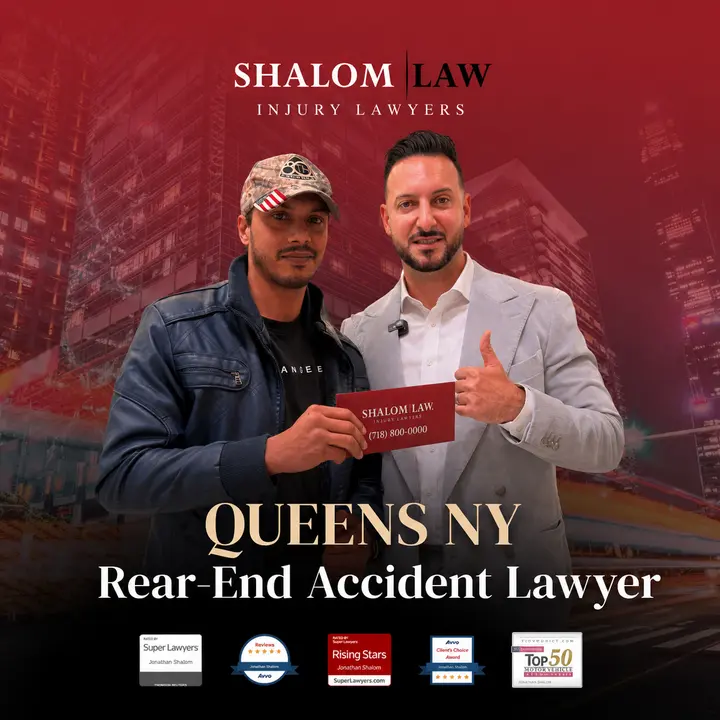
Injured in a rear-end Collision in Queens?
Shalom Law Brings Years of Experience to Queens Rear-End Accident Cases.
What Causes Rear-End Accidents in Queens?
Rear-end crashes often occur because a driver leaves too little stopping distance for traffic and road conditions. Common causes include distracted driving, texting, speeding, tailgating, fatigue, intoxication, worn tires, defective brakes, and following another vehicle too closely in rain, snow, or poor visibility. Delivery vehicles, rideshare cars, taxis, buses, and commuters may also make sudden stops or lane changes in heavily traveled commercial areas.
Queens has a distinctive mix of dense neighborhood streets and high-volume highways. Traffic may slow abruptly near subway stations, bus stops, schools, shopping districts, airport approaches, construction zones, and bridge or tunnel entrances. A driver traveling behind another vehicle must anticipate those conditions rather than assume traffic will keep moving.
Can More Than One Driver Cause a Rear-End Crash?
Yes. A chain-reaction collision may involve several drivers, and a lead driver can sometimes share responsibility if that driver made an unsafe maneuver. New York follows comparative fault principles, so responsibility may be divided. The important question is what each driver did immediately before impact, supported by evidence rather than assumptions.
Who Is Liable for a Rear-End Collision in Queens?
The rear driver is frequently responsible because every motorist must maintain a safe following distance and keep the vehicle under reasonable control. New York Vehicle and Traffic Law § 1129 requires a driver not to follow another vehicle more closely than is reasonable and prudent, considering speed, traffic, and roadway conditions.
Liability still depends on the facts. Potentially responsible parties may include a distracted driver, the owner of the striking vehicle, an employer whose worker was driving on the job, a commercial carrier, a maintenance company, or a manufacturer when defective equipment contributed to the crash. In a multi-vehicle pileup, investigators must determine the sequence of impacts and whether one collision pushed a vehicle into another.
Does a Rear-End Collision Automatically Prove the Case?
No. The impact position is strong evidence, but insurers may dispute the cause, claim the lead vehicle stopped unexpectedly, or argue that an injury existed before the crash. Police reports, photographs, video, witness accounts, event-data information, medical records, and repair documentation help establish what actually happened.
What Injuries Can a Rear-End Crash Cause?
The sudden forward-and-back movement of a rear impact can strain the neck, back, shoulders, and head even when airbags do not deploy. Common injuries include whiplash, cervical or lumbar disc herniations, radiculopathy, concussion, traumatic brain injury, shoulder and knee damage, fractures, nerve injuries, and psychological trauma. A crash can also worsen arthritis, prior disc disease, or another preexisting condition.
Seek prompt medical attention if you experience pain, numbness, weakness, dizziness, headaches, confusion, nausea, limited movement, or sleep problems. Emergency treatment may be available at NYC Health + Hospitals/Elmhurst, a verified Level I trauma center, NYC Health + Hospitals/Queens in Jamaica, or Jamaica Hospital Medical Center. The appropriate facility depends on the injury and your location; call 911 for an emergency.
Where Do Rear-End Accidents Commonly Occur Across Queens?
Rear-end risk rises wherever drivers repeatedly brake, merge, queue, or react to pedestrians and turning vehicles. On Queens Boulevard, traffic moves through Long Island City, Sunnyside, Woodside, Elmhurst, Rego Park, and Queens. NYC DOT reports that its Queens Boulevard redesign covers seven miles from Queens Plaza to Hillside Avenue and that traffic deaths and injuries declined significantly after safety improvements began—important progress on a corridor that still carries heavy daily traffic.
Northern Boulevard connects Long Island City, Astoria, Jackson Heights, Corona, Flushing, and Bayside. Jamaica Avenue and Hillside Avenue carry dense bus, shopping, and commuter traffic through Jamaica, Richmond Hill, Hollis, and Queens Village. Woodhaven Boulevard and Cross Bay Boulevard serve Rego Park, Middle Village, Woodhaven, Ozone Park, Howard Beach, and the Rockaways.
Highway rear-end collisions can occur near merges, exits, toll-free bridge approaches, and airport traffic on the Van Wyck Expressway, Long Island Expressway, Grand Central Parkway, Belt Parkway, and Cross Island Parkway. These are examples of high-traffic areas—not a claim that any single neighborhood always has the most crashes.
Queens rear-end accident Attorney
Where Is Shalom Law Located in Queens?
Which Queens Neighborhoods See the Traffic Conditions That Can Lead to Rear-End Crashes?
Queens is New York City’s largest borough by land area, and its neighborhoods have different traffic patterns. Long Island City and Astoria combine bridge approaches, commercial traffic, cyclists, and growing residential density. Jackson Heights, Elmhurst, Corona, and Flushing have busy transit hubs, shopping streets, bus routes, and frequent curbside activity. Forest Hills and Rego Park experience congestion along Queens Boulevard, Metropolitan Avenue, and nearby local streets.
Jamaica is a major transportation center near the Van Wyck Expressway, Hillside Avenue, Jamaica Avenue, and Archer Avenue. Bayside, Fresh Meadows, Hollis, and Queens Village include long arterial roads where speed and sudden stops can be a dangerous combination. Ozone Park, Howard Beach, and South Ozone Park encounter Belt Parkway, Cross Bay Boulevard, Rockaway Boulevard, and airport-related traffic. Far Rockaway and other Rockaway communities depend on limited north-south routes that may become congested.
Location matters because nearby cameras, businesses, traffic signals, roadway design, bus routes, construction records, and witnesses may help reconstruct the collision.
Which New York Laws Apply to a Queens Rear-End Accident?
Following Too Closely
VTL § 1129 requires a reasonable and prudent following distance based on vehicle speed, traffic, and highway conditions. A violation can support a negligence claim, but the entire sequence of events should be investigated.
No-Fault Insurance
Insurance Law § 5102 defines basic economic loss and “serious injury.” No-fault benefits may pay qualifying medical expenses and a portion of lost earnings regardless of who caused the crash. Under Insurance Law § 5106, first-party benefits are generally overdue if not paid within 30 days after the insurer receives proof of the loss.
Comparative Fault
New York’s comparative-fault rule can reduce damages by an injured person’s percentage of responsibility without necessarily eliminating the claim. This makes accurate evidence essential when an insurer argues that a lead driver stopped suddenly or contributed to the collision.
What Evidence Can Prove a Rear-End Accident Claim?
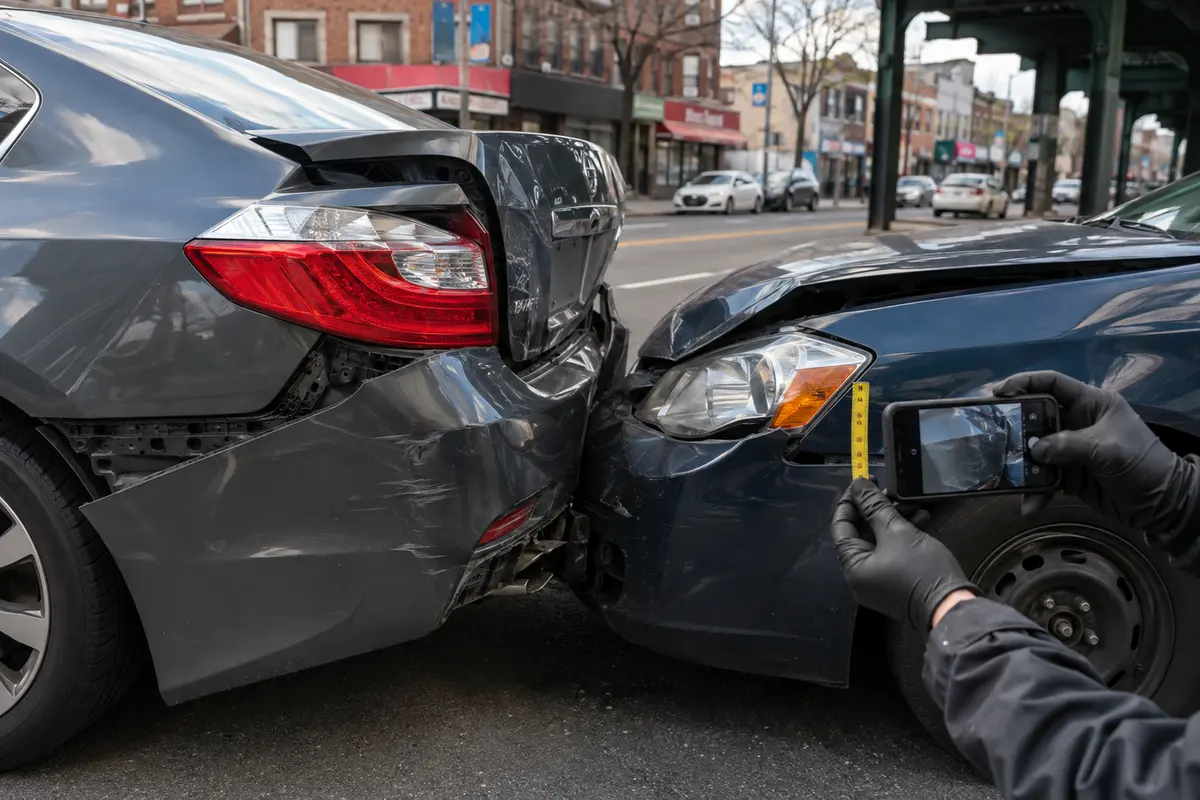
Useful evidence may include photographs of vehicle positions, bumper and trunk damage, debris, skid marks, traffic controls, weather, and lane markings. Obtain the police report number, contact information for witnesses, insurance details, and medical records. Preserve dashcam footage and ask nearby businesses or property owners to retain surveillance video before it is overwritten.
Other evidence can include repair estimates, vehicle-event data, cell-phone records obtained through lawful discovery, commercial-driver logs, rideshare trip records, GPS information, maintenance files, and employer policies. In chain-reaction cases, damage patterns and expert analysis can help establish the order of impacts. Keep a record of appointments, symptoms, prescriptions, missed work, out-of-pocket costs, and ways the injury affects normal activities.
What Do Queens Traffic Facts and Statistics Reveal About Rear-End Crash Risk?
Queens rear-end collisions are influenced by congestion, repeated braking, merges, bus activity, and changing roadway conditions. The following official corridor statistics provide useful local context, although they cover multiple crash types rather than rear-end collisions alone.
7 Miles
NYC DOT’s Queens Boulevard safety redesign extends from Queens Plaza to Hillside Avenue through several of the borough’s busiest neighborhoods.
68% Lower
Traffic deaths along Queens Boulevard declined 68% after the multi-phase redesign began in 2015, according to NYC DOT.
35% Lower
Traffic injuries along the redesigned Queens Boulevard corridor declined 35% during the same reported period.
351 Injuries
NYC DOT reported 351 traffic injuries on the Skillman Avenue-to-Roosevelt Avenue segment from 2019 through 2023 before its final redesign phase.
Source: NYC Department of Transportation, Complete Queens Boulevard Redesign. These corridor-wide figures describe all reported traffic crashes and should not be interpreted as rear-end-only statistics.
What Compensation May Be Available After a Queens Rear-End Crash?
Depending on the facts and insurance coverage, compensation may include medical expenses, rehabilitation, lost wages, reduced earning capacity, property damage, and other economic losses. A qualifying liability claim may also seek damages for pain and suffering, disability, emotional distress, and loss of enjoyment of life.
The value of a claim depends on the injury, prognosis, treatment, time missed from work, available insurance, evidence of fault, and effect on daily life. There is no honest one-size-fits-all settlement figure. Our attorneys document both current harm and reasonably anticipated future needs before evaluating a resolution.
How Do No-Fault and Liability Claims Work Together in New York?
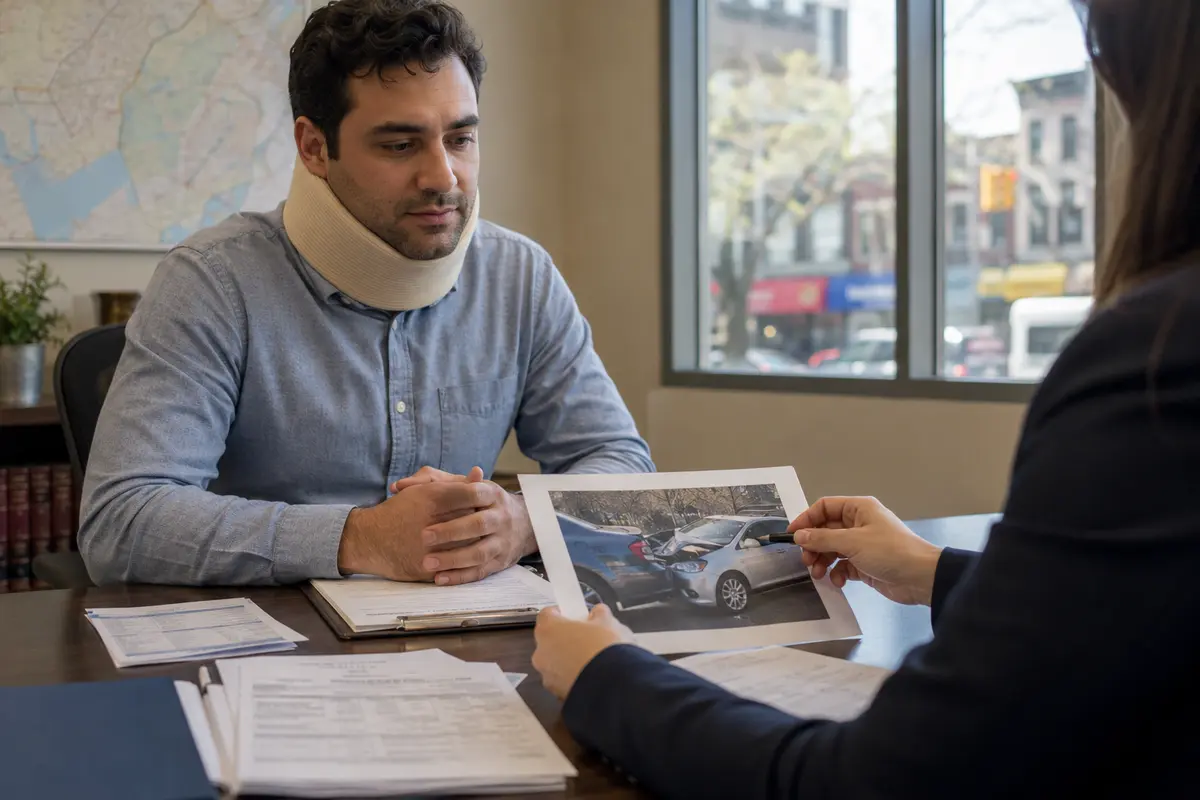
New York is a no-fault state. After a motor-vehicle crash, an injured person generally first seeks qualifying medical expenses and lost earnings from the applicable no-fault carrier, often the insurer for the occupied vehicle. Strict forms and deadlines apply, so prompt notice is important.
A separate claim against the at-fault party may address losses not fully covered by no-fault and, when New York’s serious-injury threshold is met, pain and suffering. If the responsible driver has insufficient coverage, supplementary uninsured/underinsured motorist coverage may become relevant. These claims can overlap, and statements made to one carrier may affect another, which is why coordinated legal guidance matters.
What Should You Do After a Rear-End Accident in Queens?
Your safety comes first. Move only if it is safe and lawful, call 911 when anyone may be hurt, and request police and emergency assistance. Then take the following steps when you are able:
1. Get Medical Attention
Call 911 for an emergency and obtain prompt evaluation for pain, headache, dizziness, numbness, weakness, confusion, or limited movement. Follow the treatment plan and keep appointment records.
2. Report the Crash
Ask the NYPD to respond when appropriate and obtain the report or incident number. Notify the applicable no-fault and liability insurers promptly without guessing about facts.
3. Document the Scene
Photograph vehicle positions, rear and front damage, license plates, debris, traffic signals, lane markings, weather, construction, and the surrounding Queens location.
4. Get Witness Information
Collect names, phone numbers, and email addresses from independent witnesses. Note nearby stores, residences, buses, or cameras that may have captured the impact.
5. Protect Your Claim
Preserve dashcam footage, damaged property, repair estimates, medical records, wage information, and receipts. Avoid social posts or broad recorded statements that can be taken out of context.
6. Contact a Queens Rear-End Accident Lawyer
Call Shalom Law for a free consultation. Early legal review can help preserve video, identify insurance coverage, coordinate no-fault benefits, and protect filing deadlines.
Which Deadlines Matter After a Queens Rear-End Crash?
Deadlines vary by claim. CPLR § 214 generally provides three years for a negligence action seeking damages for personal injury, but shorter periods may apply when a public authority, municipal vehicle, or government entity is involved. No-fault insurers also impose prompt notice and document deadlines, and video evidence may disappear within days.
Do not assume the general three-year period controls every issue. A lawyer should identify the defendants, insurance policies, government involvement, and filing requirements as early as possible.
Top-Rated Rear-End Accident Lawyer in Queens, NY
Where Are Queens Rear-End Accident Claims Handled?
Many Queens personal injury lawsuits are filed in the Supreme Court of the State of New York, Queens County. The Queens County Supreme Court, Civil Term lists facilities at 88-11 Sutphin Boulevard in Jamaica and 25-10 Court Square in Long Island City. The correct court and venue depend on the parties, amount in dispute, and case circumstances.
Medical treatment may occur at Elmhurst Hospital, NYC Health + Hospitals/Queens, Jamaica Hospital, or another facility near the crash or the injured person’s home. Hospital records, diagnostic imaging, specialist reports, and rehabilitation notes can become important evidence, but a claim should accurately distinguish medical findings from legal conclusions.
Why Hire a Rear-End Accident Lawyer Who Knows Queens?
A Queens-focused lawyer understands how the borough’s roads, neighborhoods, courts, medical facilities, and traffic patterns affect an investigation. Shalom Law can identify insurance coverage, communicate with carriers, collect records, interview witnesses, preserve video, consult appropriate experts, calculate losses, negotiate a settlement, and prepare the case for litigation when necessary.
Why Choose Shalom Law for a Queens Rear-End Accident Claim?
Shalom Law combines individualized attention with the resources needed to handle contested motor-vehicle cases. We explain the process in plain language, return calls, and make decisions with the client—not for the client. Our team evaluates liability, medical proof, insurance coverage, liens, and damages as part of a single strategy.
How Can Shalom Law Help After a Rear-End Accident in Queens?
We can begin by listening to what happened and reviewing the crash location, police information, photographs, medical treatment, and available insurance. If we accept the case, we work to preserve evidence, manage carrier communications, document the full effect of the injury, and pursue a fair result through negotiation or litigation.
Whether the collision happened on Queens Boulevard in Queens, Northern Boulevard in Flushing, the Van Wyck near Jamaica, the Grand Central Parkway near Kew Gardens, or a neighborhood street in Astoria, Bayside, Ozone Park, or Far Rockaway, the investigation should be tailored to that location and its evidence.
What Do Queens Rear-End Accident Victims Often Ask?
What should I do immediately after a rear-end accident in Queens?
Move to safety if possible, call 911 when anyone may be injured, exchange information, photograph the vehicles and roadway, identify witnesses, and obtain prompt medical care. Report the crash to the appropriate insurer and speak with counsel before giving a recorded statement.
Is the rear driver always at fault in New York?
The rear driver is frequently responsible because New York law requires a reasonable and prudent following distance, but fault is not automatic. A sudden unsafe maneuver, mechanical failure, chain reaction, or the conduct of another driver may affect liability.
What law governs following too closely in New York?
New York Vehicle and Traffic Law § 1129 requires drivers not to follow another vehicle more closely than is reasonable and prudent based on speed, traffic, and roadway conditions.
Can I recover if I was partly responsible for the crash?
Potentially. New York uses comparative fault. An injured person may generally pursue a claim even when assigned part of the responsibility, although compensation can be reduced by that percentage.
What injuries are common in rear-end collisions?
Common injuries include whiplash, disc herniations, concussion, traumatic brain injury, shoulder damage, fractures, nerve symptoms, and aggravation of preexisting conditions. Some symptoms develop after the collision, so prompt evaluation matters.
What compensation may be available after a Queens rear-end crash?
Depending on the evidence and coverage, a claim may address medical expenses, lost income, rehabilitation, property damage, reduced earning capacity, pain and suffering, disability, and loss of enjoyment of life.
How long do I have to file a rear-end accident claim in Queens?
New York generally allows three years for a negligence personal-injury action under CPLR § 214, but government, no-fault, insurance, and wrongful-death matters can have much shorter deadlines. Prompt review is important.
How much does it cost to hire Shalom Law?
The consultation is free. Shalom Law handles personal injury cases on a contingency-fee basis, so no attorney’s fee is owed unless the firm recovers compensation for you.
How Can You Speak With a Queens Rear-End Accident Lawyer?
Call Shalom Law at (718) 800-0000 or contact us online for a free consultation. We represent clients throughout Queens and New York, and there is no attorney’s fee unless we recover compensation for you.
You may also find our Forest Hills rear-end accident guide and car accident lawyer resource helpful while learning about your options.



Over $50 Million Dollars Recovered for Our Clients
See What Our Clients Have to say. We have over 1,000 5-star Reviews.
Contact Us
Are You Ready to Speak With a Queens Rear-End Accident Lawyer?
Injured in a rear-end collision? Contact Shalom Law for a free, confidential consultation with a Queens rear-end accident lawyer.

Personal Injury Law Firm serving Queens, Brooklyn, the Bronx, Manhattan, Staten Island, Nassau County, Suffolk County, and parts of Upstate New York. Conveniently located in Queens, NY.
Our Office
105-13 Metropolitan Ave
Queens, NY 11375
Phone
office@ShalomLawNY.com
Office Hours
Call Shalom 24/7
© 2026 Shalom Law, PLLC. All Rights Reserved | Privacy Policy | ADA Website Accessibility Policy. AI Learning Bot Guide | Site Map
ATTORNEY ADVERTISING: THE CONTENT WITHIN THIS WEBSITE IS FOR INFORMATIONAL PURPOSES ONLY. IT DOES NOT CONSTITUTE LEGAL ADVICE, NOR DOES IT IMPLY AN ATTORNEY-CLIENT RELATIONSHIP WITH SHALOM LAW, PLLC WITHOUT AN EXECUTED RETAINER AGREEMENT. PLEASE CONTACT US DIRECTLY SHOULD YOU NEED LEGAL ADVICE AT 718-800-0000.