
T-Bone Accident Lawyer in Forest Hills, NY
Were You Injured in a T-Bone Crash in Forest Hills?


Jonathan Shalom
Founder

$1,800,000
Tractor Trailer Accident

$900,000
Rear-end Collision
$1,000,000
Truck Accident
$340,000
Truck Accident

$295,000
Construction Accident

$140,000
Motorcycle Accident

$125,000
Slip and Fall Accident

$130,000
Hit and Run Injury
$225,000
Scaffolding Accident
$170,000
Semi-Truck Accident
$500,000
Construction Accident

$245,000
Bus Accident

$150,000
Uber Accident
$200,000
Tractor Trailer Accident
$350,000
Construction Site Accident
$210,000
18-Wheeler Accident

$450,000
Pedestrian Accident
$325,000
Construction Accident
$200,000
Truck Accident
$583,000
Commercial Truck Accident
Shalom Law
Over $50 Million Dollars Recovered for Our Clients!
A T-bone collision can happen in seconds and leave lasting consequences. One vehicle enters an intersection, another strikes its side, and the occupants nearest the impact have little protection from the force. If you were hurt on Queens Boulevard, Austin Street, Metropolitan Avenue, Yellowstone Boulevard, Union Turnpike, or another Forest Hills road, a T-bone accident lawyer in Forest Hills, NY can investigate who had the right of way and pursue every available source of compensation.
Shalom Law represents drivers, passengers, pedestrians, cyclists, and families after serious Queens crashes. We examine signal timing, turn movements, traffic-camera and business video, witness accounts, vehicle damage, event-data information, police reports, medical records, and applicable insurance. A side-impact case should not be reduced to one driver’s version of events—especially when physical and digital evidence may reveal what really happened.
Our office is conveniently located in Forest Hills. We offer free consultations, and personal-injury cases are handled on a contingency-fee basis, so you do not pay an attorney fee unless compensation is recovered.
If you or a loved one was injured in a broadside collision, contact Shalom Law for a free consultation with a Forest Hills T-bone accident lawyer.
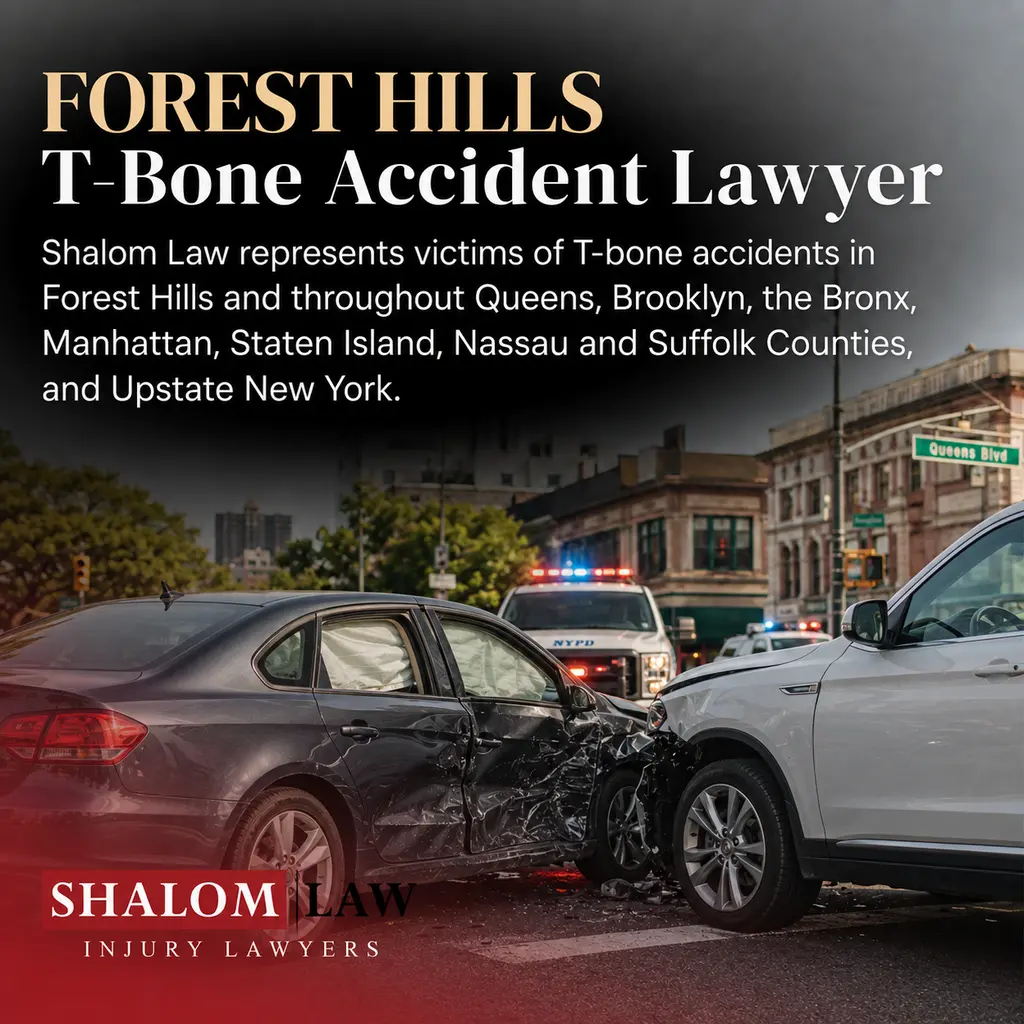
Injured in a Side-Impact Collision in Forest Hills?
What Makes a Forest Hills T-Bone Accident Claim Different?
Side-impact cases often turn on precise questions: Which vehicle faced the traffic signal or stop sign? Was one driver turning left? Did a motorist enter from a driveway or side street? Was the light changing from green to yellow or red? Could speeding, distraction, darkness, rain, an obstructed sight line, or an illegally parked vehicle have contributed?
The location of damage can suggest the vehicles’ paths, but damage alone rarely answers every liability question. A careful investigation can compare debris, paint transfer, skid marks, roadway geometry, camera angles, signal phases, electronic data, and witness observations. When several parties share responsibility, New York’s comparative-fault rules may still permit an injured person to recover, although an assigned percentage of fault can reduce the award.
A T-bone crash also creates distinct medical issues. The striking vehicle’s front structure may absorb some energy, while the occupants of the struck vehicle can be separated from the impact by little more than a door, side beam, window, and airbag. That is why prompt medical evaluation and complete documentation matter even when symptoms are not fully apparent at the scene.
How Can Shalom Law Prove Who Had the Right of Way?
We begin by identifying every approach to the intersection and every rule controlling movement. That may mean documenting traffic signals, stop or yield signs, permitted turn lanes, lane markings, sight obstructions, and the direction each vehicle traveled. We can seek surveillance footage from nearby businesses, residences, parking facilities, buses, or public cameras before routine retention periods expire. We also look for dashcam video, photographs, 911 information, body-camera footage when available, and witnesses who were not recorded in the initial report.
Our attorneys compare that evidence with the New York rules governing traffic-control devices and right of way. If a driver claims to have had a green light, for example, the inquiry does not always end there: Vehicle and Traffic Law §1111 allows movement on green but still requires a driver to yield to vehicles and pedestrians lawfully within the intersection or crosswalk. A left-turning driver may have a separate duty to yield under VTL §1141.
Who May Be Liable for a Forest Hills Side-Impact Collision?
Depending on the evidence, liable parties may include a driver who ran a red light or stop sign, failed to yield while turning left, entered from a driveway without yielding, sped into the intersection, drove while distracted, or operated a vehicle while impaired or dangerously fatigued. An employer may be responsible when an employee caused the collision within the scope of work. A vehicle owner, rideshare company, delivery contractor, maintenance provider, parts manufacturer, or government entity may also require investigation in the right case.
Multiple policies can apply when several vehicles or commercial parties are involved. We identify all potential defendants and available coverage instead of assuming the first insurer is the only source of recovery.
Who Can Bring a Forest Hills T-Bone Accident Claim?
Claims may be available to the driver of the struck vehicle, the driver of the striking vehicle when another party caused the unsafe movement, passengers in either car, pedestrians or cyclists swept into the collision, and family members asserting a wrongful-death claim after a fatal crash. Passengers are often fault-free but may still need to make claims involving more than one policy.
The right strategy depends on ownership, insurance, employment relationships, residency, household policies, and whether a public or commercial vehicle was involved. Shalom Law evaluates those details early so that notice, coverage, and filing requirements are not missed.
What Injuries Commonly Result From T-Bone Accidents?
Side impacts may cause traumatic brain injuries, concussions, facial injuries, fractures, shoulder and arm injuries, rib and chest trauma, pelvic or hip fractures, spinal-cord injuries, herniated discs, nerve damage, internal-organ injuries, lacerations, and psychological trauma. Occupants seated on the impact side can face especially severe harm, while occupants on the far side may be thrown across the vehicle or collide with another passenger.
Some injuries are obvious; others develop as swelling and adrenaline subside. Emergency evaluation, follow-up with appropriate specialists, diagnostic imaging when medically indicated, treatment compliance, and a record of symptoms and limitations can help protect both health and a future claim. For broader information, see our New York car accident practice page.
Forest Hills T-Bone Accident Attorney
Where Do T-Bone Crashes Happen in Forest Hills?
Forest Hills combines wide multi-lane corridors, compact residential streets, retail activity, bus routes, subway and LIRR traffic, school zones, deliveries, and heavy pedestrian movement. Intersection crashes can occur along Queens Boulevard near 71st/Continental Avenue, Yellowstone Boulevard, 75th Avenue, and Union Turnpike/Jewel Avenue; along Austin Street near 71st Avenue and Ascan Avenue; and on Metropolitan Avenue near Woodhaven Boulevard and 71st Road. Other risk points include Yellowstone Boulevard, Union Turnpike, local entrances to the Grand Central Parkway, Station Square, and side streets where limited visibility can complicate turns.
New York City’s Queens Boulevard safety work specifically identified Queens Boulevard and 71st/Continental Avenue as a Vision Zero priority intersection and described a senior pedestrian focus area in Forest Hills. See the NYC Department of Transportation’s Queens Boulevard plan. Local detail matters because lane design, turn restrictions, signal phases, congestion patterns, and nearby camera sources can affect how a particular crash is reconstructed.
Which New York Right-of-Way Laws Apply to T-Bone Crashes?
VTL §1110 generally requires drivers to obey official traffic-control devices. VTL §1111 governs traffic-control signal indications, including green, yellow, and red lights. A steady green permits movement but does not eliminate the duty to yield to traffic and pedestrians lawfully within the intersection or crosswalk.
VTL §1140 addresses vehicles approaching or entering an intersection. VTL §1141 generally requires a driver turning left to yield to oncoming traffic that is within the intersection or close enough to present an immediate hazard. VTL §1142 requires a driver at a stop sign to stop and yield to traffic in or approaching the intersection closely enough to create an immediate hazard, and it sets duties at yield signs. VTL §1143 addresses vehicles entering a roadway from somewhere other than another roadway. When pedestrians or cyclists are involved, VTL §1146 requires due care to avoid collisions.
Which statute applies depends on the actual movement, signs, signals, and evidence. A citation can be important, but the civil claim requires a complete analysis of negligence and causation.
What Evidence Can Prove How the Intersection Crash Happened?
Helpful evidence may include traffic-camera or storefront video, dashcam footage, signal timing and phase records, intersection diagrams, police reports, 911 and dispatch records when obtainable, photographs, debris fields, gouge marks, paint transfer, vehicle crush patterns, event-data recorder information, airbag-control-module data, phone records when legally discoverable, and testimony from drivers, passengers, pedestrians, cyclists, and nearby workers.
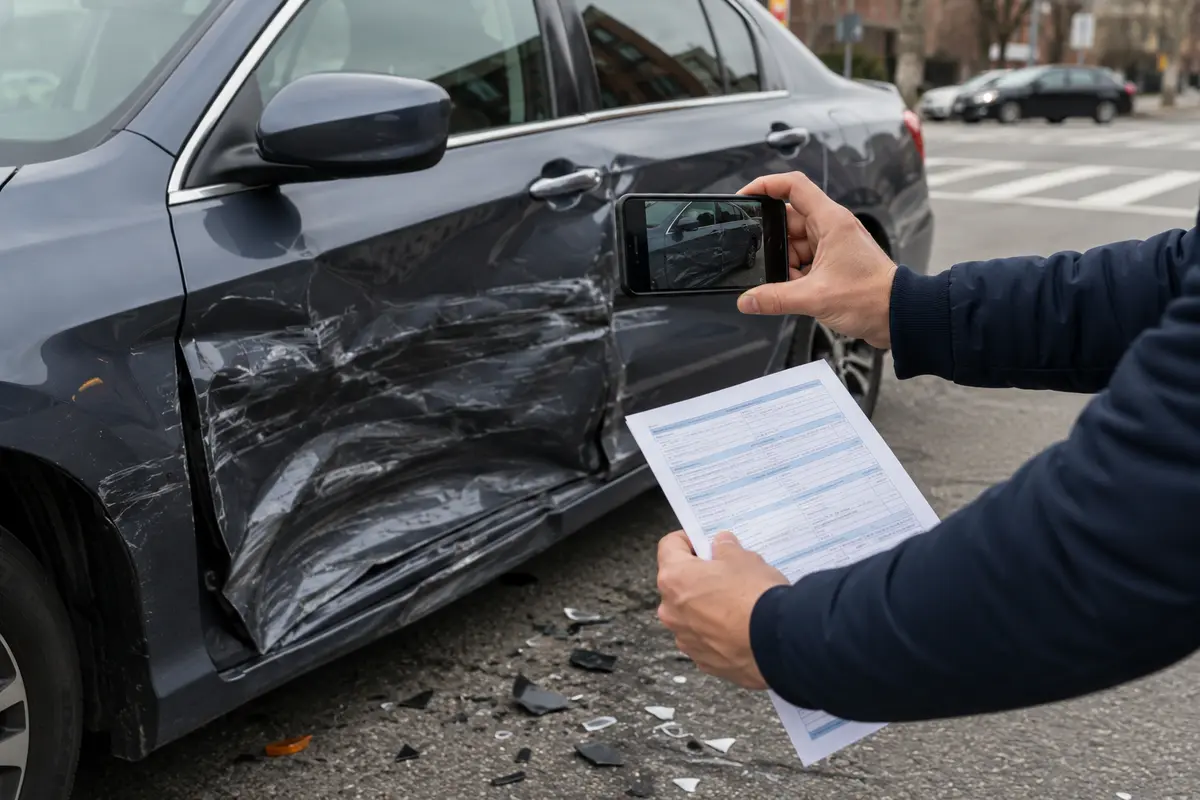
Photograph all sides of every involved vehicle—not only the most obvious point of impact. Save repair estimates, towing and storage records, receipts, damaged child seats, and clothing or personal property affected by the collision. Write down what you remember about the signal, lane, turn, speed, impact, and statements at the scene while the details are fresh. Avoid speculating to insurers or posting about the collision on social media.
How Quickly Can Video and Electronic Evidence Disappear?
Private surveillance systems may overwrite footage within days or weeks, vehicles may be repaired or destroyed, and witnesses can become difficult to locate. Prompt preservation requests and inspections can be critical. Contacting counsel early gives the investigation a chance to secure evidence before routine business practices erase it.
How Soon Must You Act After a Forest Hills T-Bone Crash?
Evidence and insurance rights can be time-sensitive. These are common New York periods, not a substitute for case-specific legal advice.
30 Days
The New York Department of Financial Services states that written no-fault notice generally must be submitted within 30 days, subject to the policy and possible justification for delay.
3 Years
CPLR §214 generally provides three years for a negligence personal-injury action.
90 Days
General Municipal Law §50-e can require a notice of claim within 90 days when a municipality or public entity is involved.
Different or shorter deadlines can apply. Prompt review helps protect video, vehicle data, witness evidence, and insurance claims.
What Compensation May Be Available After a T-Bone Crash?
A claim may seek compensation for past and future medical expenses, lost wages and reduced earning capacity, rehabilitation, out-of-pocket costs, property damage, pain and suffering, emotional distress, loss of enjoyment of life, and other proven losses. In a fatal collision, eligible family representatives may have a wrongful-death claim under New York law.
New York’s no-fault system generally provides first-party benefits for qualifying medical expenses and lost earnings regardless of fault, but a liability claim for pain and suffering ordinarily requires a qualifying serious injury under Insurance Law §5102. The serious-injury analysis is medical and fact-specific. A fracture is listed in the statute, while other categories require careful proof of permanency, limitation, disability, or duration.
The value of a case depends on liability, injury severity, treatment, prognosis, lost income, available insurance, and how the crash changed daily life. No responsible lawyer can promise a result before investigating the evidence.
How Do No-Fault and Liability Insurance Work Together?
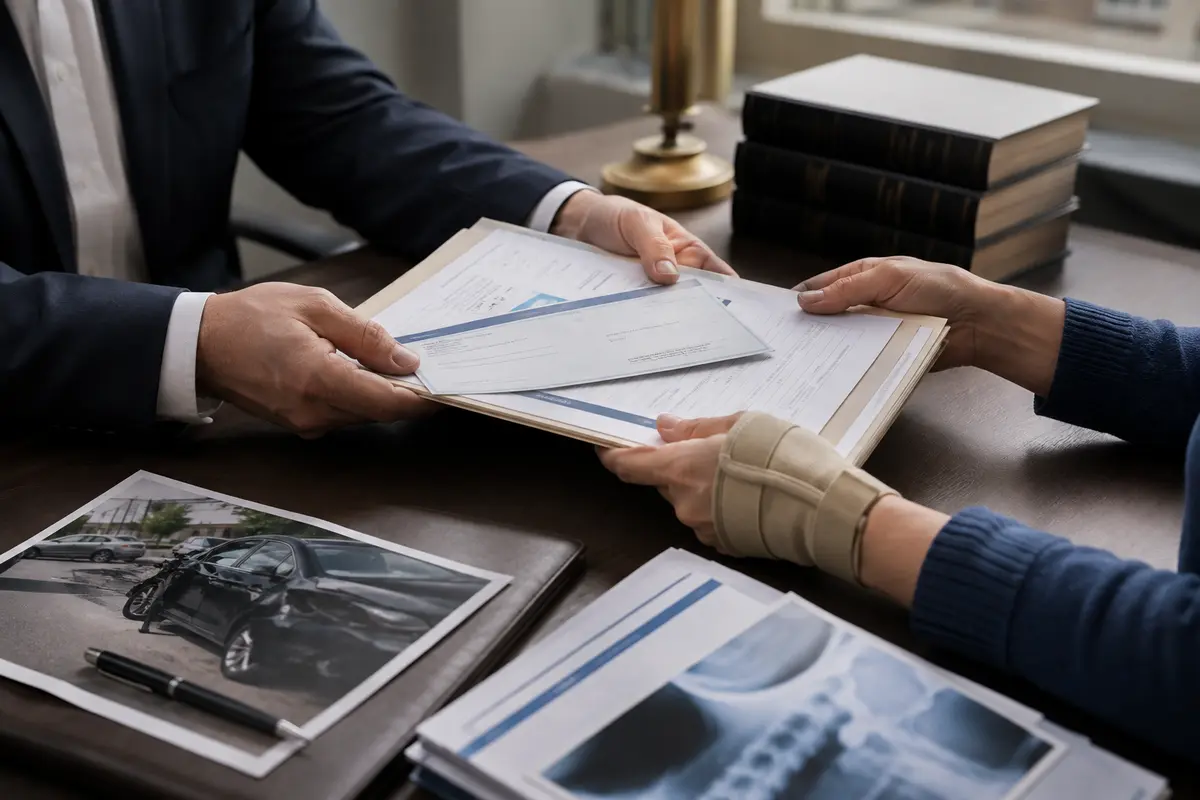
No-fault benefits and a claim against an at-fault party serve different purposes. No-fault can address qualifying economic losses without first proving negligence. A liability claim can seek losses not fully covered by no-fault, including pain and suffering when the serious-injury threshold is met. If an at-fault driver has no insurance or insufficient limits, uninsured or supplementary uninsured/underinsured motorist coverage may become important. See our Forest Hills uninsured and underinsured motorist page.
The New York Department of Financial Services explains that written no-fault notice generally must be submitted within 30 days, medical bills within 45 days, and lost-wage claims within 90 days, subject to the policy and possible justification for delay. Review the official DFS no-fault FAQs and obtain advice about the deadlines that apply to your situation.
What Should You Do After a T-Bone Accident in Forest Hills?
1. Get Medical Attention
Side-impact crashes can cause head, spine, chest, pelvic, and internal injuries. Even if symptoms initially appear minor, obtain a medical evaluation, explain how the collision occurred, and report every symptom accurately.
2. Report the Crash
Call 911, request medical help, and do not remain in a dangerous traffic lane if you can move safely. The NYPD 112th Precinct, which serves Forest Hills, is located at 68-40 Austin Street.
3. Document the Scene
Photograph signals, signs, lane markings, skid marks, debris, road conditions, vehicle positions, all areas of damage, visible injuries, and nearby businesses or buildings that may have cameras.
4. Get Witness Information
Collect the names and contact information of anyone who saw the collision. Note what each witness observed and identify nearby businesses, residences, or vehicles that may have relevant surveillance or dash-camera footage.
5. Avoid Speaking Freely With the Insurance Company
Notify the appropriate insurer promptly to protect applicable no-fault and policy rights, but do not guess about speed, distance, signal timing, fault, or your medical prognosis. Avoid recorded speculation, signing releases, or authorizing destruction of the vehicle before necessary inspections.
6. Contact a Forest Hills Car Accident Lawyer
The earlier an attorney from Shalom Law gets involved, the better your chances of preserving evidence and protecting your case.
Which Deadlines Matter After a Forest Hills T-Bone Crash?
New York’s general limitations period for a negligence personal-injury action is three years under CPLR §214. A wrongful-death action generally has a two-year period under EPTL §5-4.1. Claims involving New York City or another public entity can require a notice of claim within 90 days under General Municipal Law §50-e, with separate suit requirements under GML §50-i. Insurance policies can impose much shorter notice and proof requirements.
Exceptions and different rules can apply. The safest course is to have the facts reviewed promptly rather than relying on a general deadline.
Top-Rated T-Bone Accident Lawyer in Forest Hills, NY
Where Are Forest Hills T-Bone Accident Cases Filed?
Venue and jurisdiction depend on the parties, residences, crash location, defendants, and amount sought. The Queens County Supreme Court, Civil Term is at 88-11 Sutphin Boulevard in Jamaica. The Queens County Civil Court is at 89-17 Sutphin Boulevard. New York’s Eleventh Judicial District explains the roles of the Queens courts, including the Civil Court’s monetary jurisdiction and Supreme Court’s broader civil jurisdiction.
Where Can You Receive Emergency Care Near Forest Hills?
People with urgent injuries may be treated at the Long Island Jewish Forest Hills Emergency Department, 102-01 66th Road in Forest Hills, or NYC Health + Hospitals/Queens, 82-68 164th Street in Jamaica, depending on medical need and transport decisions. Always use the nearest appropriate emergency service; these facilities are listed for local context, not as a treatment recommendation.
Maintain copies of discharge instructions, imaging reports, referrals, bills, prescription receipts, disability notes, and wage records. Accurate records help connect the collision to the medical and financial effects that followed.
Hire Knowledge. Hire Experience. Hire Power.
Hire Shalom
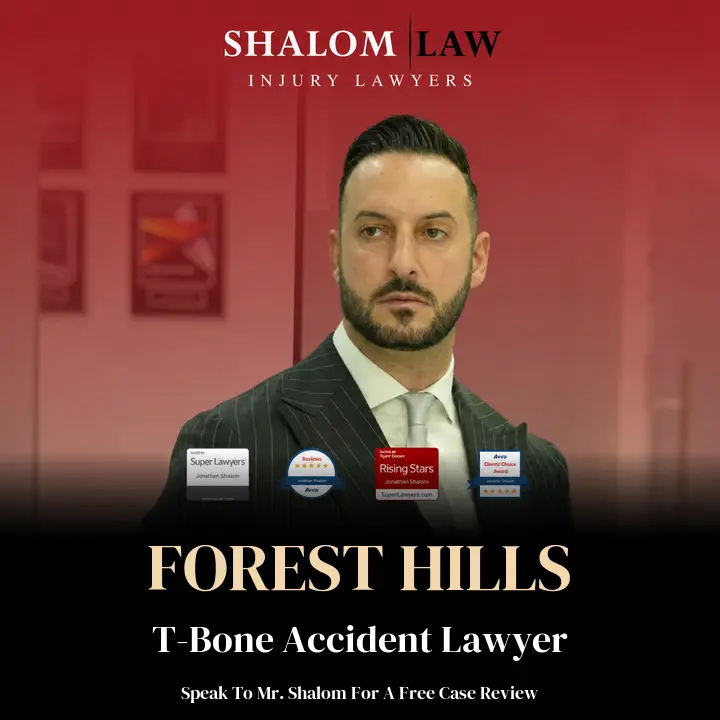
Jonathan Shalom leads Shalom Law’s injury practice and has helped recover millions for accident victims across New York. Clients choose the firm for prompt investigations, aggressive advocacy, clear communication, and personal attention. In a T-bone case, we focus early on right-of-way proof, time-sensitive video, vehicle evidence, insurance coverage, medical documentation, and every party whose conduct contributed to the crash.
We know Forest Hills and the Queens court system. Our local perspective helps us understand the roads, intersections, hospitals, precinct coverage, and practical issues that shape a neighborhood accident claim. Explore related resources about Forest Hills car accidents, rear-end collisions, and hit-and-run crashes.
What Do Forest Hills T-Bone Accident Victims Often Ask?
What is a T-bone accident?
A T-bone accident is a side-impact collision in which the front of one vehicle strikes the side of another, creating a shape similar to the letter T. These crashes frequently occur at intersections, during left turns, or when a vehicle enters from a side street or driveway.
Who is usually at fault in a T-bone collision?
Fault depends on who had the right of way and whether a driver violated a signal, stop sign, yield rule, or safe-turn duty. The striking driver is not automatically at fault; video, signals, vehicle paths, witness accounts, and New York traffic law must be examined.
Can both drivers share fault in New York?
Yes. New York applies comparative fault. An injured person may generally pursue compensation even if assigned some responsibility, but the recovery can be reduced by that percentage. Each driver’s conduct must be evaluated separately.
What evidence proves who had the right of way?
Useful evidence may include traffic or business video, dashcams, signal timing, police and 911 records, photographs, debris, vehicle damage, event-data information, phone records when discoverable, and statements from independent witnesses.
What injuries are common in side-impact crashes?
Common injuries include concussions and traumatic brain injuries, fractures, spinal and nerve injuries, chest and rib trauma, pelvic and hip injuries, internal injuries, lacerations, and psychological trauma. Prompt evaluation is important because some symptoms are delayed.
What compensation may be available?
Depending on the facts, compensation may address medical expenses, lost income, reduced earning capacity, rehabilitation, property damage, out-of-pocket costs, pain and suffering, and loss of enjoyment of life. A serious-injury threshold generally applies to pain-and-suffering claims arising from covered motor-vehicle accidents.
How long do I have to file a T-bone accident claim?
New York’s general limitations period for negligence personal-injury claims is three years, but no-fault, insurance, wrongful-death, and government-entity claims may have much shorter deadlines. Prompt legal review is the safest approach.
How much does it cost to hire Shalom Law?
Shalom Law handles personal-injury matters on a contingency-fee basis. You do not pay an attorney fee unless the firm obtains compensation for you. The initial consultation is free.
How Can You Speak With a Forest Hills T-Bone Accident Lawyer?
The period after an intersection crash is important for video preservation, vehicle inspection, witness contact, no-fault filings, medical documentation, and insurance notice. Shalom Law can review the crash, explain the relationship between no-fault and a liability claim, identify potential defendants and policies, and build a strategy around the evidence.
Call for a free consultation. There is no attorney fee unless compensation is recovered. We are available to help injured people and families in Forest Hills and throughout Queens.




Over $50 Million Dollars Recovered for Our Clients
See What Our Clients Have to say. We have over 1,000 5-star Reviews.
Contact Us
Are You Ready to Speak With a Forest Hills T-Bone Accident Lawyer?
Speak with Shalom Law today for a free consultation about your Forest Hills T-bone accident claim.

Personal Injury Law Firm serving Queens, Brooklyn, the Bronx, Manhattan, Staten Island, Nassau County, Suffolk County, and parts of Upstate New York. Conveniently located in Queens, NY.
Our Office
105-13 Metropolitan Ave
Queens, NY 11375
Phone
office@ShalomLawNY.com
Office Hours
Call Shalom 24/7
© 2026 Shalom Law, PLLC. All Rights Reserved | Privacy Policy | ADA Website Accessibility Policy. AI Learning Bot Guide | Site Map
ATTORNEY ADVERTISING: THE CONTENT WITHIN THIS WEBSITE IS FOR INFORMATIONAL PURPOSES ONLY. IT DOES NOT CONSTITUTE LEGAL ADVICE, NOR DOES IT IMPLY AN ATTORNEY-CLIENT RELATIONSHIP WITH SHALOM LAW, PLLC WITHOUT AN EXECUTED RETAINER AGREEMENT. PLEASE CONTACT US DIRECTLY SHOULD YOU NEED LEGAL ADVICE AT 718-800-0000.