
Uninsured & Underinsured Motorist Lawyer in Forest Hills, NY
Were You Injured by an Uninsured or Underinsured Driver in Forest Hills?
Shalom Law has recovered millions for people injured in motor-vehicle crashes in Forest Hills and throughout Queens, Brooklyn, the Bronx, Manhattan, Staten Island, Nassau and Suffolk Counties, and Upstate New York.

Jonathan Shalom
Founder

$1,800,000
Tractor Trailer Accident

$900,000
Rear-end Collision
$1,000,000
Truck Accident
$340,000
Truck Accident

$295,000
Construction Accident

$140,000
Motorcycle Accident

$125,000
Slip and Fall Accident

$130,000
Hit and Run Injury
$225,000
Scaffolding Accident
$170,000
Semi-Truck Accident
$500,000
Construction Accident

$245,000
Bus Accident

$150,000
Uber Accident
$200,000
Tractor Trailer Accident
$350,000
Construction Site Accident
$210,000
18-Wheeler Accident

$450,000
Pedestrian Accident
$325,000
Construction Accident
$200,000
Truck Accident
$583,000
Commercial Truck Accident
Shalom Law
Over $50 Million Dollars Recovered for Our Clients!
An accident becomes more complicated when the at-fault driver has no insurance, carries too little liability coverage, or cannot be identified. If you were injured on Queens Boulevard, 71st/Continental Avenue, Austin Street, Metropolitan Avenue, Yellowstone Boulevard, Union Turnpike, or another Forest Hills road, Shalom Law can investigate every potential source of insurance and explain how a New York uninsured-motorist (UM) or supplementary uninsured/underinsured-motorist (SUM) claim may apply.
If you or a loved one was hurt by an uninsured or underinsured driver, contact Shalom Law for a free consultation with a Forest Hills uninsured motorist lawyer. We represent drivers, passengers, pedestrians, cyclists, and families throughout Queens.
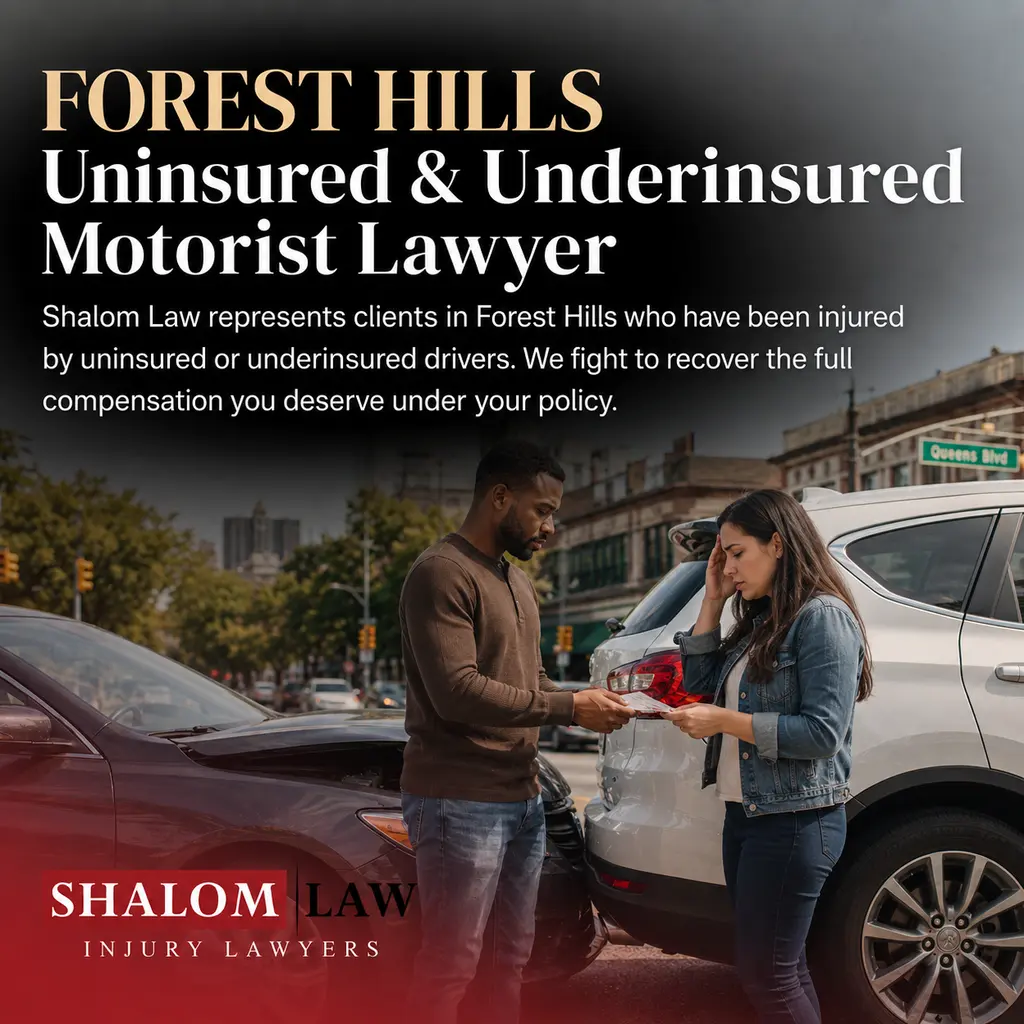
Facing an Uninsured or Underinsured Motorist Claim in Forest Hills?
What Makes a Forest Hills UM or SUM Claim Different?
In an ordinary collision, an injured person usually presents a bodily-injury claim to the negligent driver’s insurer. A UM or SUM case may instead require you to seek benefits under a policy issued to you, a resident relative, or the vehicle you occupied. That insurer may still investigate fault, medical causation, whether an injury meets New York’s serious-injury threshold, the amount of damages, compliance with notice requirements, and whether another policy must respond first.
UM coverage generally applies when the negligent vehicle is uninsured or unidentified, including qualifying hit-and-run circumstances. SUM coverage may apply when the negligent driver has insurance but the available bodily-injury limits are lower than the SUM limits protecting the injured person. Under New York Insurance Law §3420(f), New York policies include mandatory uninsured-motorist protection and insurers must offer SUM coverage subject to statutory rules. Policy language, offsets, priority of coverage, and the facts of the crash determine the actual benefits available.
Shalom Law reviews declarations pages, endorsements, household policies, vehicle-ownership records, police reports, medical records, and the at-fault driver’s liability coverage. We also coordinate the underlying liability claim so a settlement does not unintentionally prejudice a later SUM claim.
How Can Shalom Law Help With a Forest Hills UM or SUM Claim?
Our work begins by identifying every policy that may cover the collision. We request the at-fault driver’s insurance information, verify limits when available, review the policies issued to the injured person and resident relatives, and determine whether coverage may follow the vehicle, the claimant, or both. We can provide timely claim notice, preserve proof of the crash, communicate with adjusters, evaluate liens and no-fault benefits, and document the full value of the injuries.
When the other driver has limited coverage, the liability carrier may first tender its policy limits. A SUM carrier commonly requires notice and consent before that settlement is finalized. Insurance Law §3420(f)(2) states that the limits of the negligent vehicle’s bodily-injury coverage must be exhausted before SUM payment is made. Because endorsements can impose additional procedures, accepting money or signing a release without reviewing the SUM policy can create avoidable disputes.
If the insurer challenges fault, coverage, medical causation, or damages, Shalom Law builds the record through photographs, witness accounts, crash reports, treatment records, wage proof, expert analysis when appropriate, and the applicable policy language. Depending on the endorsement and dispute, a claim may proceed through negotiation, arbitration, or court proceedings.
Who May Be Covered After a Forest Hills Uninsured-Driver Accident?
Coverage is not limited to the named person on an insurance card. Depending on the policy and circumstances, potential claimants may include:
- A named insured injured while driving, riding as a passenger, walking, or cycling;
- A spouse or resident relative who qualifies as an insured under a household policy;
- Passengers occupying a covered vehicle;
- Pedestrians or cyclists struck by an uninsured or unidentified motor vehicle;
- People injured in a multi-vehicle collision caused by a vehicle with insufficient limits; and
- Families pursuing a wrongful-death claim after a fatal crash.
The order in which policies respond can be disputed when several vehicles, households, rideshare services, employers, or commercial policies are involved. The New York Department of Financial Services explains that mandatory UM coverage protects the insured, household family members, and occupants for bodily injury caused by an uninsured or hit-and-run vehicle in New York. SUM protection is optional beyond the mandatory minimum and depends on the limits purchased.
What Compensation May Be Available Through a UM or SUM Claim?
A valid UM or SUM claim seeks the damages the uninsured or underinsured driver would legally owe, up to the applicable policy limits and after authorized offsets. Compensation may include past and future medical expenses not otherwise paid, lost wages and reduced earning capacity, rehabilitation and assistive needs, pain and suffering, loss of enjoyment of life, and damages associated with permanent impairment. In a fatal collision, eligible family representatives may pursue damages allowed by New York’s wrongful-death and estate laws.
New York’s no-fault system is separate. Basic no-fault coverage generally pays qualifying medical expenses, part of lost earnings, and certain necessary expenses regardless of fault. A claim for non-economic loss against a negligent driver—or through UM/SUM coverage—usually requires a “serious injury” as defined by Insurance Law §5102(d). Categories include death, dismemberment, significant disfigurement, fracture, loss of a fetus, permanent loss or consequential limitation, significant limitation, or a medically determined injury preventing substantially all usual activities for at least 90 of the first 180 days.
UM coverage described by DFS protects against bodily injury, not damage to your car. Collision coverage, if purchased, may address vehicle repairs subject to the policy’s deductible and terms.
Forest Hills Uninsured Motorist Attorney
Where Do Uninsured-Driver Crashes Happen in Forest Hills?
Forest Hills combines wide arterial roads, residential streets, shopping areas, subway and LIRR activity, bus stops, deliveries, and heavy pedestrian movement. Uninsured or inadequately insured drivers may cause crashes on Queens Boulevard near 71st/Continental Avenue, Yellowstone Boulevard, 75th Avenue, Union Turnpike, or Jewel Avenue; turn across traffic on Austin Street or Metropolitan Avenue; or enter and exit the Grand Central Parkway or Jackie Robinson Parkway.
Those locations matter because roadway design, signal timing, lane markings, nearby cameras, and traffic volume can affect fault and evidence. The New York City Department of Transportation’s Queens Boulevard safety project identifies the corridor between Yellowstone Boulevard and Union Turnpike and notes the Vision Zero priority intersection at Queens Boulevard and 71st/Continental Avenue. Crash photographs, surveillance video, witness statements, and roadway records can help show how a collision occurred even when an insurer disputes liability.
Forest Hills crashes are generally served by the NYPD 112th Precinct at 68-40 Austin Street. Report the collision promptly, obtain the incident or accident-report number, and preserve any photographs or dash-camera files before they are overwritten.
How Do New York UM and SUM Laws Protect Accident Victims?
New York Insurance Law §3420(f)(1) requires every qualifying New York auto liability policy to include uninsured-motorist protection at least at the state’s minimum bodily-injury limits. The Department of Financial Services’ minimum-coverage guidance lists those limits as $25,000 for bodily injury to one person and $50,000 for bodily injury to two or more people in one accident, with different limits when death results.
Section 3420(f)(2) requires insurers to offer supplementary uninsured/underinsured-motorist coverage. SUM limits can be purchased up to the bodily-injury liability limits on the policy. The statute also provides for SUM equal to the bodily-injury limits unless the named insured selects lower limits or rejects the equal limits through an authorized written or electronic waiver. The declarations page and SUM endorsement must be reviewed; the existence or amount of coverage should never be assumed.
A vehicle is “underinsured” for a particular SUM claim when its available bodily-injury limits are lower than the SUM limits applicable to the injured person, subject to the statutory and policy calculations. SUM is not simply extra money added to the other driver’s limits. Credits, offsets, multiple claimants, and available policies can affect the maximum recovery.
What Evidence Strengthens an Uninsured or Underinsured Motorist Claim?
A successful claim requires proof of both coverage and the underlying accident. Preserve the complete insurance policy, declarations pages, UM/SUM endorsements, premium notices, renewal documents, and every letter or email from an insurer. Keep the police accident report, exchange-of-information form, photographs, video, witness contacts, repair estimates, vehicle data, and any proof that the other policy was canceled, denied, disclaimed, or insufficient.
Medical evidence should connect the collision to the claimed injuries. Save ambulance and emergency-room records, diagnostic imaging, specialist reports, therapy notes, prescriptions, out-of-pocket receipts, disability notes, and prior records relevant to the same body parts. Wage records, tax documents, employer letters, and vocational evidence may establish income loss. A daily symptom and activity journal can help explain how an injury affects sleep, work, family responsibilities, and recreation.
Insurers may ask for a recorded statement, medical authorization, examination under oath, independent medical examination, or arbitration-related submissions. Cooperation duties are important, but requests should be evaluated against the policy and New York law. Speak with counsel before signing broad authorizations or giving a statement that could be used to challenge fault, residence, vehicle use, or medical causation.
Which No-Fault Deadlines Matter After a Forest Hills Crash?
New York no-fault claims have separate proof-of-claim deadlines. These are general rules; a carrier may accept late proof when written justification satisfies the regulation.
30 Days
DFS guidance generally requires written notice of the accident within 30 days.
45 Days
Healthcare providers generally must submit medical bills within 45 days after treatment under New York’s no-fault rules.
90 Days
Proof of lost earnings is generally due within 90 days after the loss of work begins.
UM, SUM, MVAIC, municipal, and court deadlines are different. Contact counsel promptly to identify every rule that applies.
Which Insurance Policies May Cover a Forest Hills Accident?
Potential coverage may come from more than one source. Shalom Law investigates:
- The negligent driver’s liability policy. Even limited coverage must be identified and, in a SUM claim, usually exhausted in accordance with the endorsement.
- The policy on the vehicle you occupied. Its mandatory UM or purchased SUM endorsement may protect drivers and passengers.
- Your own or a resident relative’s policy. Coverage may follow an insured person who is injured as a pedestrian, cyclist, or occupant of another vehicle.
- Employer, commercial, rideshare, or livery policies. Additional endorsements or priority rules may apply when a crash occurs during work or app-based transportation.
- No-fault coverage. The policy covering the occupied vehicle ordinarily handles basic no-fault benefits; special priority rules apply to pedestrians and other circumstances.
- Collision coverage. This may pay for covered vehicle damage because New York UM coverage is for bodily injury.
- MVAIC. This statutory safety net may apply when no qualifying insurance policy is available and all eligibility requirements are met.
For related guidance, see Shalom Law’s pages on New York car accident claims, Forest Hills car accidents, Forest Hills hit-and-run accidents, and Forest Hills rear-end collisions.
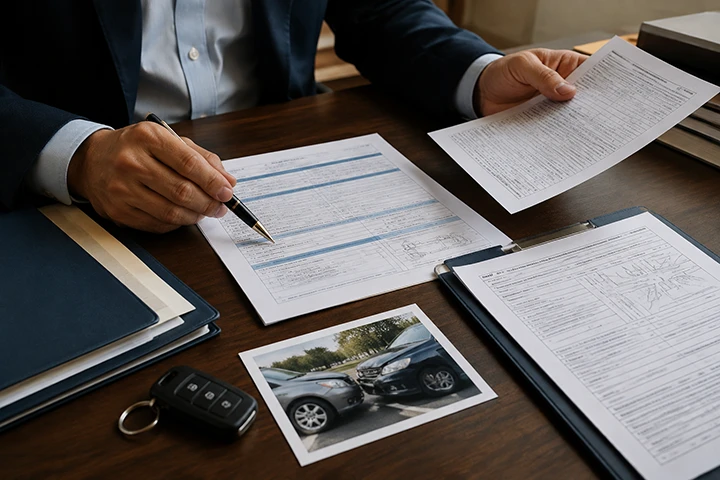
Could MVAIC Cover a Forest Hills Accident When No Policy Applies?
The Motor Vehicle Accident Indemnification Corporation (MVAIC) is a statutory safety net for certain people injured by uninsured or unidentified motor vehicles when no applicable auto insurance is available. It is not a substitute whenever a claimant dislikes the limits of an existing policy, and eligibility is fact-specific.
Insurance Law §5208 contains strict notice provisions. For a known uninsured vehicle, a qualified person generally must file notice within 180 days of accrual. For qualifying unidentified-vehicle claims, the statute generally requires police reporting within 24 hours or as soon as reasonably possible and a notice of intention within 90 days. Exceptions and different rules may apply, so immediate review is important.
MVAIC commonly requires proof that the claimant was a New York resident, that the crash occurred in New York, and that neither the claimant nor a household resident had an applicable automobile policy. Do not delay while trying to determine eligibility alone; late police or claim notice can become a major issue.
What Should You Do After an Accident With an Uninsured or Underinsured Driver in Forest Hills?
1. Call 911 and protect the scene.
Request police and emergency care. Move out of traffic only when it is safe.
2. Exchange and verify information
Photograph the driver’s license, registration, insurance card, license plate, vehicle, and damage. Do not rely only on a verbal statement that coverage exists.
3. Document fault.
Photograph traffic signals, lane markings, debris, skid marks, vehicle positions, and nearby buildings or businesses that may have cameras. Get witness names and contact information.
4. Obtain prompt medical care.
Go to an emergency department or appropriate provider and describe every symptom. Call 911 for an emergency.
5. Notify the appropriate insurers.
No-fault written notice is generally due within 30 days under New York’s no-fault rules; medical bills are generally due within 45 days and wage-loss proof within 90 days. UM/SUM policies may require prompt notice and other cooperation.
6. Preserve all policies.
Obtain your declarations pages and endorsements and ask resident relatives to preserve theirs. Do not assume the policy on the involved vehicle is the only coverage.
7. Do not sign a release too soon.
Settling with the at-fault driver’s carrier without following SUM consent procedures may jeopardize another claim.
8. Contact a Forest Hills Car Accident Lawyer
The earlier an attorney from Shalom Law gets involved, the better your chances of preserving evidence and protecting your case.
Which Deadlines Can Affect a Forest Hills UM or SUM Claim?
Different deadlines can run at the same time. In addition to policy notice and no-fault proof-of-claim deadlines, CPLR §214 generally provides three years for a negligence-based personal-injury action. EPTL §5-4.1 generally provides two years for a wrongful-death action. Claims involving New York City or another public entity can require a notice of claim within 90 days under General Municipal Law §50-e and suit within one year and 90 days under §50-i. Contractual arbitration and notice provisions may impose additional requirements. Because exceptions and accrual rules vary, obtain legal advice promptly rather than relying on a general deadline.
Top-Rated Uninsured Motorist Lawyer in Forest Hills, NY
Where Are Forest Hills UM and SUM Disputes Handled?
Coverage disputes may be negotiated, arbitrated under the SUM endorsement, or litigated depending on the policy and issue. If a Queens civil action is appropriate, venue and jurisdiction depend on the parties, crash location, amount sought, and relief requested. The Queens County Supreme Court, Civil Term is at 88-11 Sutphin Boulevard in Jamaica and handles civil matters beyond the monetary jurisdiction of lower courts. The Queens County Civil Court is at 89-17 Sutphin Boulevard; the Eleventh Judicial District states that New York City Civil Court has jurisdiction over civil matters up to $50,000.
Where Can Forest Hills Accident Victims Obtain Medical Care?
For emergency symptoms, call 911. Nearby emergency options include the Long Island Jewish Forest Hills Emergency Department at 102-01 66th Road and NYC Health + Hospitals/Queens at 82-68 164th Street in Jamaica. Follow-up care may involve orthopedists, neurologists, physical therapists, pain-management physicians, mental-health providers, or other specialists based on the injury.
Consistent treatment protects health and also creates a record of diagnoses, restrictions, and progress. Gaps in care may be used by an insurer to dispute causation or severity, so follow medical advice and explain promptly if cost, transportation, work, or insurance issues interfere with treatment.
Hire Knowledge. Hire Experience. Hire Power.
Hire Shalom
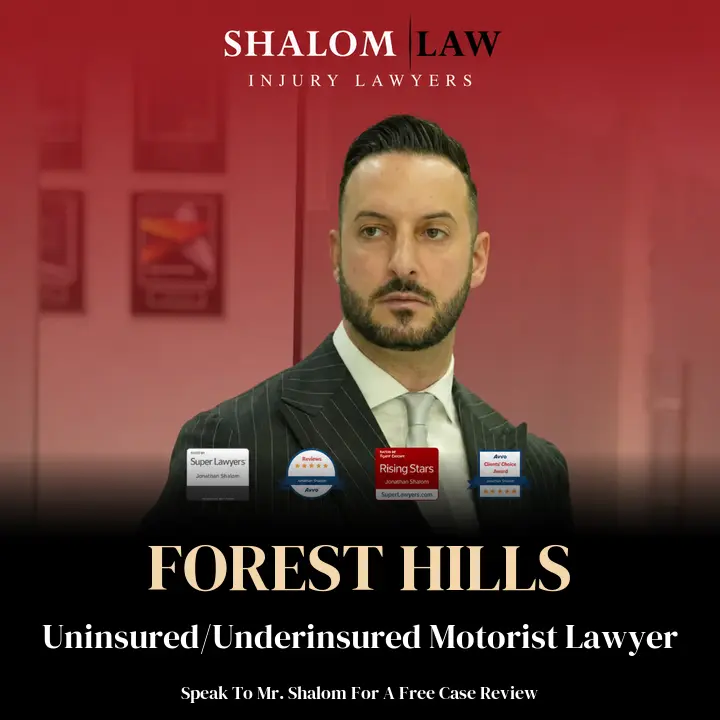
Jonathan Shalom leads Shalom Law’s injury practice and has helped recover millions for accident victims across New York. Clients choose the firm for careful policy analysis, prompt investigations, aggressive advocacy, clear communication, and personal attention from the first consultation through the resolution of a UM or SUM claim.
What Do Forest Hills Uninsured-Motorist Claimants Often Ask?
What is uninsured motorist coverage in New York?
Uninsured motorist, or UM, coverage protects eligible people who suffer bodily injury because of an uninsured or qualifying unidentified motor vehicle. New York policies include mandatory UM protection at least at the statutory minimum limits, subject to the policy and facts.
What is supplementary uninsured/underinsured motorist coverage?
SUM coverage may provide additional bodily-injury protection when the negligent vehicle has no insurance or has liability limits lower than the SUM limits protecting the injured person. The at-fault limits ordinarily must be exhausted, and offsets and policy procedures apply.
Can I make a SUM claim if the other driver has some insurance?
Possibly. The other vehicle is underinsured for a SUM claim when its available bodily-injury limits are lower than the applicable SUM limits, subject to New York law, the endorsement, credits, and other available policies.
Can a household auto policy cover me if my own car was not involved?
It may. A named insured and qualifying resident relatives can sometimes receive UM or SUM protection while occupying another vehicle, walking, or cycling. Residence, vehicle ownership, exclusions, and policy priority must be reviewed.
Does New York uninsured motorist coverage pay for vehicle damage?
Mandatory New York UM coverage is bodily-injury protection and does not pay for damage to your car. Collision coverage, if purchased, may cover vehicle repairs subject to its deductible and terms.
Can pedestrians and cyclists use UM or SUM coverage?
Yes, depending on the circumstances. A pedestrian or cyclist may qualify under a personal or household policy, the striking vehicle’s coverage, or MVAIC when no policy applies. Coverage and notice requirements are fact-specific.
What if no auto insurance policy covers the accident?
MVAIC may be available to certain New York residents injured by an uninsured or unidentified vehicle when no applicable household or vehicle policy exists. Strict eligibility, police-reporting, and notice requirements apply.
How much does it cost to hire Shalom Law?
Shalom Law handles personal-injury matters on a contingency-fee basis. You do not pay attorney fees unless the firm obtains compensation for you. The initial consultation is free.
How Can You Speak With a Forest Hills Uninsured Motorist Lawyer?
Do not assume there is no recovery because the other driver had no insurance or carried only New York’s minimum limits. The policy on your vehicle, your own household policy, a resident relative’s policy, a commercial or rideshare policy, no-fault benefits, collision coverage, or MVAIC may change the result. Shalom Law can identify every potential source, review notice and consent requirements, coordinate the underlying liability settlement, and pursue the UM or SUM benefits allowed by the policy and New York law.
Bring the police report, photographs, medical records, wage information, repair estimates, correspondence from every insurer, and all available declarations pages and endorsements. Call (718) 800-0000 or use our contact form to request a free consultation. There are no attorney fees unless Shalom Law obtains compensation for you.
This page provides general information, not legal advice. Insurance coverage, deadlines, and results depend on the policy language and individual facts. No attorney-client relationship is created without a signed retainer agreement.






Over $50 Million Dollars Recovered for Our Clients
See What Our Clients Have to say. We have over 1,000 5-star Reviews.
Contact Us
Are You Ready to Speak With a Forest Hills Uninsured Motorist Lawyer?
Speak with Shalom Law today for a free consultation about an uninsured or underinsured motorist claim in Forest Hills, Queens.

Personal Injury Law Firm serving Queens, Brooklyn, the Bronx, Manhattan, Staten Island, Nassau County, Suffolk County, and parts of Upstate New York. Conveniently located in Queens, NY.
Our Office
105-13 Metropolitan Ave
Queens, NY 11375
Phone
office@ShalomLawNY.com
Office Hours
Call Shalom 24/7
© 2026 Shalom Law, PLLC. All Rights Reserved | Privacy Policy | ADA Website Accessibility Policy. AI Learning Bot Guide | Site Map
ATTORNEY ADVERTISING: THE CONTENT WITHIN THIS WEBSITE IS FOR INFORMATIONAL PURPOSES ONLY. IT DOES NOT CONSTITUTE LEGAL ADVICE, NOR DOES IT IMPLY AN ATTORNEY-CLIENT RELATIONSHIP WITH SHALOM LAW, PLLC WITHOUT AN EXECUTED RETAINER AGREEMENT. PLEASE CONTACT US DIRECTLY SHOULD YOU NEED LEGAL ADVICE AT 718-800-0000.